

If your cat had thumbs and a credit card, your home would look very different. There would be more shelves. The window perches would be load-bearing. The litter box situation would have been overhauled months ago. Whatever the size of your home, what makes it work for a cat is rarely about square footage. It’s about how the space is set up: where the boxes live, what’s at eye level, where the cat can hide when company shows up, and whether daily life gives them anything interesting to do.
At Liberty Veterinary Hospital in Liberty Township, we’re an AAHA-accredited practice that sees plenty of indoor cats and the particular puzzles of life with one (or three). Routine visits are a good chance to check in on both physical and behavioral health, since the two are more connected than most people realize. Request an appointment or reach out with questions anytime.
Reading Your Cat’s Mood (And Yes, They Can Be Moody)
Cats are not the inscrutable enigmas they pretend to be. They communicate constantly, just not very loudly. Learning to read what they’re saying is the foundation of a working relationship.
Purring usually means contentment, but it can also mean stress, pain, or self-soothing in a cat who is anxious or unwell. Context tells you which one. A cat purring in your lap with eyes half-closed is having a great time. A cat purring while hidden under the bed is asking for help in the only way they know how.
Beyond the soundtrack, your cat is constantly sending messages with their body. Cat body language covers the tail (high and quivering means hello, tucked low means worry, puffed means do not approach), the ears (forward is interested, flat is in trouble, sideways is annoyed), the eyes (slow blinks are little kisses, dilated pupils mean something is up, squinting is contentment), and the overall posture (loose and stretched is happy, crouched and tense is not).
Sudden changes in any of this deserve attention. A cat who is suddenly hiding when they used to greet you at the door, vocalizing at 3 a.m. when they used to sleep through the night, or stopping a behavior they used to do regularly is telling you something has changed. Sometimes that change is environmental. Sometimes it’s medical. We can help sort out which.
Litter Boxes: Where Most Problems Start
If anything in your home setup is going to drive both you and your cat crazy, it will probably be the litter box situation. The good news is that this is also the easiest thing to get right.
Box Size, Shape, and Lid Drama
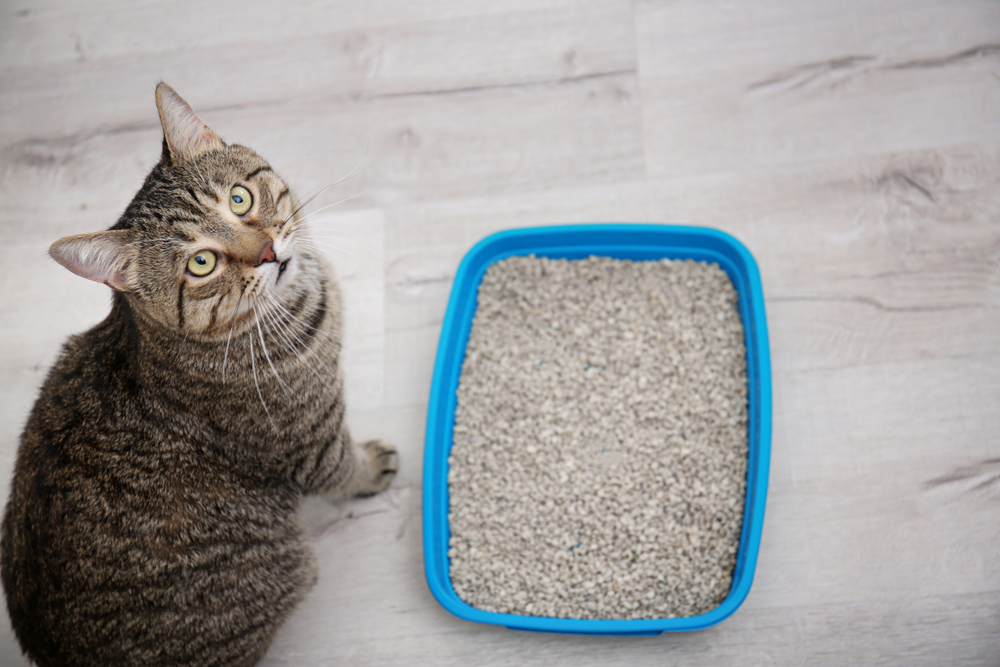
Most boxes sold for cats are honestly too small for adult cats. The general rule is that the box should be at least 1.5 times the length of your cat from nose to tail base. If you have ever wondered why your cat seems to position themselves so weirdly that they hang half off the edge, this is your answer.
Open boxes are simplest, easiest to clean, and what most cats prefer. Covered boxes contain odor and litter scatter but can also trap odor in ways some cats hate, and they cut off a cat’s ability to see who might be sneaking up. Top-entry boxes save floor space and look tidy, but they ask your cat to jump in and out, which can become impossible for senior or arthritic cats. Furniture-style enclosures hide the box visually but need decent ventilation and easy cleaning access.
The classic litter box rule is one box per cat plus one extra. Two cats need three boxes. This sounds excessive until you’ve watched cats negotiate access to a single box, at which point it suddenly makes sense.
Where to Put Them
Quiet is the main thing. A box next to the washing machine that fires up at unpredictable times is a box your cat will eventually stop using. Spread boxes across the home rather than clustering them in one corner; in a multi-level house, that means at least one per floor. Keep boxes away from food and water, since cats are clean about not eliminating where they eat. For senior cats, low-sided entry, no jumping, and short walking distances become essential.
Daily scooping and a full litter change about once a week matter as much as box placement. A lot of house soiling problems start with marginal hygiene that the cat tolerated until they didn’t, then started using the laundry basket instead. If your cat is consistently using one specific spot off the box, the spot is information. Many cats are particular about the type of litter they like. Try a different style, location, or litter type, and book a visit if it persists. Medical conditions like urinary tract disease and kidney problems frequently show up first as a litter box issue.
Vertical Space: Your Cat’s Real Square Footage
Cats are climbers by nature. In the wild, height means safety, surveillance, and dibs on territory. Indoors, height makes a small space feel enormous to your cat and a busy household feel manageable. The space above eye level is the easiest expansion you can do.
A tall cat tree near a window does a lot of heavy lifting. Beyond that, wall-mounted shelves can become climbing pathways, modular catification furniture and cat home furnishings put together stylish climbing routes, and the top of any cleared bookshelf turns instantly into a coveted lookout. Window perches multiply the value of any climbing setup, since outside is the original cat television.
Two practical notes: anything your cat climbs on needs to be either securely mounted or substantially weighted, because a wobbly shelf is a one-time use shelf. And carpeted or fabric-covered surfaces are easier on aging joints than bare wood, especially for the landings.
In a multi-cat household, vertical space is also conflict prevention. Cats can pass each other comfortably when one of them takes the high road. They can claim a perch as their own and feel like they have something private, even in a small home. The frequent advice in addressing tension between cats is to add vertical territory before adding anything else.
Enrichment: The Daily Job of Being a Cat
Indoor cat enrichment is about giving your cat outlets for the instincts that domestication did not bother to remove. The hunting drive is fully intact. The need to investigate, climb, scratch, and stalk is fully intact. Indoor life leaves it all dressed up with nowhere to go, which is why your toes get attacked at 11 p.m.
Hunting and Play
The full hunting sequence runs: search, stalk, chase, pounce, catch, kill, eat. A good play session follows the same arc. The hunting behavior pattern wants:
- Movement that mimics prey: small, low to the ground, erratic
- Time to stalk without being rushed
- Build to a chase and pounce
- A successful catch: let your cat actually get the toy
- Food or a treat afterward to complete the sequence
If you have ever played with a cat, walked away, and then watched them stare mournfully at the wand toy on the floor, this is what was missing. Without the catch and the meal, the sequence is incomplete and the cat is left with hunting energy and nowhere to put it.
DIY enrichment toys and other DIY ideas prove that fancy is rarely necessary. Cardboard boxes, paper bags (cut the handles off), crinkle balls, feathers on string, and toilet paper tubes are all viable. Rotating toys every few days keeps things fresh, since cats become indifferent to anything they see every day.
Play Safety
A few things deserve a quick mention because they go wrong often:
- Wand toys require a human at the other end. Never leave your cat alone with one. The string is the danger.
- String, ribbon, and yarn without supervision are linear foreign body waiting to happen. The surgery for that is unpleasant for everyone involved.
- Laser pointers can frustrate cats because there is no catchable target. If you use one, finish by directing the dot onto a real toy or a treat your cat can actually grab.
- Small swallowable objects need supervision.
Variety helps. Most cats want a mix of high-action wand play, food puzzles, and quiet exploration toys.
Food as Enrichment
Cats evolved to hunt many small meals throughout the day, not to eat from a bowl twice. A bowl works, but it is wildly under-engaging for an animal designed to chase its food. Food puzzles change that. The food puzzles for cats project is a great resource for finding the right puzzle for your cat’s experience level, and there are plenty of homemade puzzle options that cost nothing to set up.
A few practical formats worth trying: puzzle feeders that require manipulation, slow feeders that stretch out a meal, treat-dispensing balls between meals, multiple feeding stations spread around the house to get your cat moving, and hand-feeding small portions to deepen your relationship with a more reserved cat. The wet versus dry food decision involves both nutrition and behavior, and many cats do well with a combination, with wet food at meals for hydration and dry food in puzzles. High-value rewards like Churu treats work especially well for training and cooperative care.
Sensory and Outdoor Enrichment
Catnip, silver vine, and valerian root engage about two-thirds of cats genetically. The other third are out of luck on this one but often respond to other novel scents. Scent-based enrichment is one of the most underused enrichment categories: introducing new safe scents (cinnamon stick, fresh herbs, a leaf from outside) gives your cat something genuinely new to investigate, which is harder to deliver than you’d think for an indoor cat. Don’t use essential oils– those are toxic to cats.
For outdoor stimulation without the risks of a free-roaming life, catios are enclosed outdoor structures that let cats experience fresh air, sunshine, and bird-watching safely. Window perches with screens are a simpler version of the same idea. Bird feeders placed near windows are also remarkably effective. Harness training works for some cats and is a complete non-starter for others; both responses are normal.
A safety note: any balcony access needs full screening or an enclosed structure. “High-rise syndrome” describes the serious injuries overly-curious cats sustain from falling off balconies, and it happens more often than people think.
Scratching the Right Things (NOT Your Couch)
Scratching is not a behavior to eliminate. Cats scratch to maintain claw health, mark territory, stretch out their backs, and communicate. The goal is redirection, not removal. The strategies for destructive scratching come down to: provide multiple scratching posts in different orientations (vertical, horizontal, angled), offer different materials (sisal rope, sisal fabric, cardboard, carpet) so your cat can show you what they prefer, place posts strategically near sleeping areas and near previously scratched furniture, make sure posts are tall enough for a full stretch and stable enough not to wobble, reward your cat when they use the right surfaces, and make the wrong surfaces less appealing with double-sided tape, plastic coverings, or foil. Regular nail trims also help reduce damage from any incidental scratching. Declawing should not be considered as an option- it’s the equivalent to cutting off your own fingertips, and linked with long-term pain.
Training Cats (Yes, Really)
Cats have a reputation for being untrainable, which is mostly slander. Cat training using clicker-based positive reinforcement builds new behaviors and modifies existing ones effectively. Cats are highly motivated by food rewards, just like dogs. They are also highly motivated by being left alone, which means short sessions of three to five minutes work better than long ones.
Positive reinforcement for good cat behavior is also the most effective way to redirect things you don’t want. Cats do not learn well from punishment. They do learn quickly when good behavior produces a reward. The general principle: reward what you want, ignore or interrupt what you don’t, and never assume a cat is being “spiteful” because they are not.
Cooperative care is one of the highest-value training applications. Teaching your cat to participate willingly in nail trims, ear checks, medication, and carrier entry pays off significantly during vet visits, grooming sessions, and home medication. Cats trained for cooperative care show measurably less stress at the vet and recover faster after procedures. Worth the time, and it’s great for mental engagement to tire out their busy brains.
When Things Go Sideways: Common Behavior Issues
Cats commonly develop a few specific problems when something is off:
- Litter box avoidance with elimination on rugs, beds, or laundry
- Inappropriate scratching on furniture or doorways
- Stress grooming producing bald patches
- Increased vocalization, especially at night
- Aggression between household cats or toward humans
- Withdrawal with hiding more than usual
Cat behavior problems usually have several contributing factors, and identifying them is the first step to fixing them. The most important question to ask first is whether there is a medical cause. Urinary tract disease, kidney disease, hyperthyroidism, arthritis, dental pain, and cognitive dysfunction can all present as behavior changes. A vet exam should always come before assuming a behavior issue is purely behavioral.
Common cat behavior issues often improve significantly with environmental enrichment, structured routines, and stress reduction. The life stressors that affect cats often look minor from a human perspective and matter enormously to the cat: a new household member, a schedule change, a piece of furniture moved across the room, a stray cat appearing in the backyard window, the doorbell ringing more than usual. For environmental support during stressful periods, products like Feliway provide synthetic feline pheromones that help cats feel more secure in their territory.
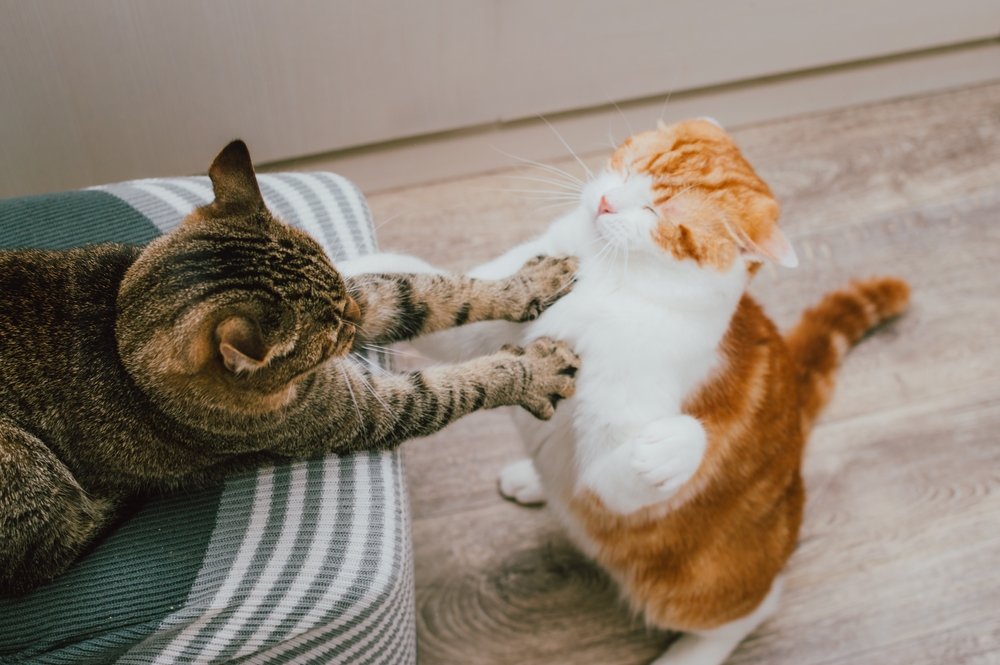
In multi-cat homes, tension between cats sometimes hides in plain sight, and what looks like enthusiastic play may actually be one cat bullying another. The signs to watch for are unequal participation (one cat consistently pursuing, the other consistently fleeing), one cat ambushing the other repeatedly, hissing or growling that escalates rather than settling, and one cat becoming reluctant to use shared resources like the litter box or food bowls. When real tension is present, adding resources (boxes, perches, hiding spots, feeding stations) and creating vertical escape routes is the first step.
Senior Cats Need a Slightly Different Setup
Older cats shift in ways that surprise people. Cognitive dysfunction can produce disorientation, altered sleep cycles, and increased nighttime vocalization. Arthritis affects jumping, climbing, and access to litter boxes with high sides. Hearing and vision decline. Anxiety about novel situations tends to grow.
Adjustments that help senior cats include lower-sided litter boxes, additional boxes positioned closer to favorite resting areas, pheromone diffusers in main living spaces, steps or ramps to favorite elevated spots, heated bedding for stiff joints, and more frequent vet check-ins to catch emerging conditions early. None of these are dramatic changes. They just acknowledge that the same cat at twelve has different daily needs than they did at four.
Putting It All Together
A cat-friendly home is rarely a bigger home. It’s the same home with the cat’s species in mind: enough boxes in the right places, vertical space to climb, daily play that finishes with a successful catch, food that takes a little effort to get to, and a few quiet places to disappear when life gets loud. Most cats don’t need a renovation. They just need a few intentional choices. For families considering bringing a new cat home, our adoption program connects people with cats in need of homes.
If you’re working through a specific issue, just want to talk through how your setup is working for your particular cat, or trying to prepare for bringing home a new friend, we’d love to help. Schedule a wellness exam or behavior consultation, and we’ll dig into the specifics. The work pays back in a calmer cat, fewer surprises, and a home that genuinely fits both of you.