

By the third fall in a row of paw licking and ear trouble, it is fair to ask why your pet's flare-ups arrive on schedule, and the reason is that allergies in dogs and cats often get worse over time. Treatment quiets the reaction, but whatever set it off is still out there waiting for next season, and each flare sets up the one after it: inflamed skin and ears let yeast and bacteria take hold, and those secondary infections keep the itch going long after the pollen count has dropped. Some pets have a single trigger for a few weeks a year; others also react to fleas or to a protein in their regular diet and barely get a break unless something in the pattern changes. That slow, skin-level cycle is a different problem from hives after a bee sting or the rare anaphylactic reaction that turns life-threatening in a matter of minutes, and telling them apart decides whether your pet needs an appointment in the coming day or two, a call to us right now, or a trip to the nearest 24-hour emergency hospital if we are closed.
Watching the same flare return every fall is tiring for the whole household, and it is also the most useful clue we have about what needs to change. Liberty Veterinary Hospital in Liberty Township is AAHA-accredited, and when your pet comes to see us for a flare, we look for the secondary ear and skin infections keeping the cycle going, work out which triggers are actually in play, and build a plan aimed at what brings it back rather than just the current round of itching. Because grooming happens right here in the hospital, we can check your pet's coat and ears while they are in for a bath, and use medicated products that help make your pet comfortable again. If allergy season has begun to feel like a fixed date on the calendar, start sorting out the pattern with us.
Allergic Reaction Basics
- Allergies are controlled, not cured, and a yearly flare usually means a trigger, a secondary infection, or both are still in play.
- Hives and a swollen face need same-day care. Collapse, vomiting with weakness, or any struggle to breathe cannot wait.
- Dogs chew their paws and get ear infections. Cats overgroom, develop crusty bumps, or get raised sores.
- Most itchy pets do best on layers: parasite prevention, medicated topicals, prescription itch control, and testing.
Which Reactions Need Us Today, and Which Need Us Now?
Which reactions can wait comes down to three tiers. Long-running itching, repeat ear trouble, and scabby skin hold fine until an appointment in the next day or two. Hives, a puffy face, or a fresh sting need same-day care. Collapse, weakness alongside vomiting, or any struggle to breathe cannot wait at all.
| How soon | What you are seeing | Your move |
| Within a day or two | Ongoing scratching, paw licking, repeat ear infections, scabs, thinning fur | Book an appointment |
| Today | Welts, a swollen muzzle or eyelids, a fresh sting, frantic face rubbing | Call and come in |
| Immediately | Collapse, pale or blue gums, vomiting with weakness, a cat breathing open-mouthed, labored breathing | The nearest open hospital |
The middle tier is the hard one. A dog covered in welts who still wants dinner may hold there, or may be thirty minutes from something far worse.
Note when the signs started and bring the wrapper, the chewed plant, or a photo. Check the gums, because pale or bluish gums mean oxygen is not reaching tissue and are a signal to move fast. Call ahead; we can often handle urgent allergic reactions during our regular hours and keep a doctor on call after we close, though a pet who is collapsing or fighting for air belongs at the nearest 24-hour emergency hospital. Never give a human combination antihistamine or cold medicine, since those products often contain decongestants or acetaminophen, and don't induce vomiting unless a veterinarian tells you to.
What's the Difference Between Hives and Anaphylaxis?
The difference between hives and anaphylaxis is how much of the body is involved. Hives usually stay skin-deep: welts that puff up within minutes to a couple of hours, sometimes with a swollen muzzle and a dog dragging their face on the carpet. Anaphylaxis is the whole body failing at once, blood pressure crashing. One needs care today, the other in minutes. Hives can be the first sign of an anaphylactic reaction, or recede without a problem.
Hives, Swollen Faces, and Urgent Stings
Through short fur, welts look lumpy and quilted; under a thick coat they hide until you run your hands down your pet's sides. Most settle with treatment, though we still want eyes on them, because the reaction can keep climbing after you think it has peaked. A sting on the face, in the mouth, or at the throat can swell an airway shut. Several stings deliver a bigger venom load, and any sting with wobbliness, breathing changes, or vomiting is no longer a fat lip.
When a Reaction Becomes Anaphylaxis
A dog in anaphylaxis often looks like a dog who got into the garbage, and the resemblance costs minutes. Vomiting, diarrhea, weakness, and collapse lead the way, because the liver and gastrointestinal tract is hit first. It makes anaphylaxis in dogs easy to underestimate at home. Cats fail from the airway instead: open-mouth breathing, which is always abnormal in a cat, plus drooling, a stretched-out neck, and gums losing color. These reactions begin within five to thirty minutes of exposure and do not resolve on their own.
Why Won't My Pet Stop Scratching, Licking, and Shaking Their Head?
Your pet won't stop because chronic allergic skin disease runs in a loop. The allergy inflames skin and ears, inflamed tissue invites yeast and bacteria, and the secondary infection itches worse than the original trigger ever did. Care aimed only at this month's infection buys a few good weeks and little more.
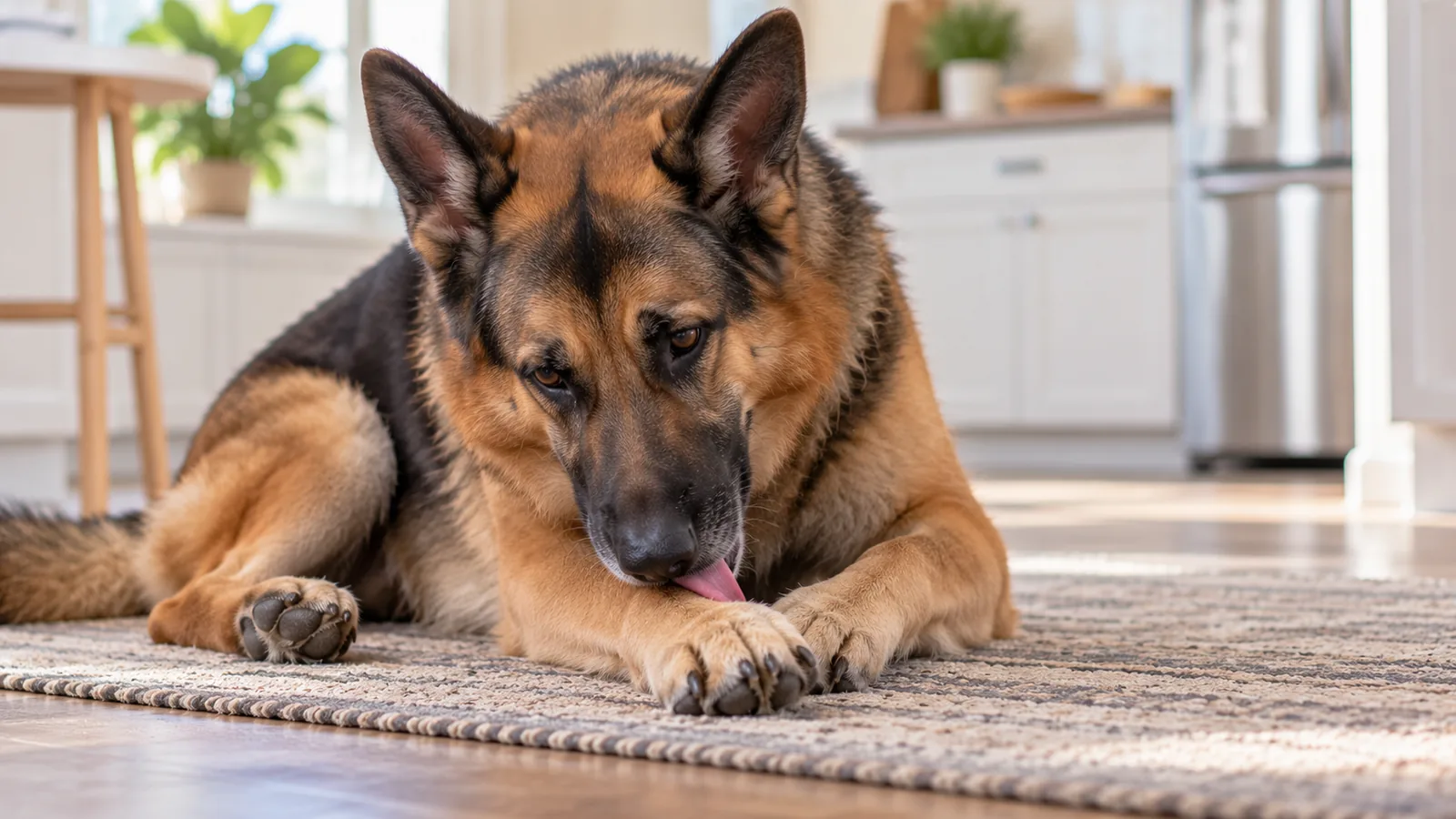
- In dogs: Feet give it away, with red, puffy skin between the toes, called pododermatitis, and rust-colored saliva staining on pale fur. Ears follow, with head shaking, repeat otitis externa, and a yeasty smell. Licked long enough, one patch becomes a hot spot overnight, raw and oozing and spreading fast.
- In cats: The bald patch is what gets noticed, since cats groom in private. Symmetrical hair loss along the belly, inner legs, or flanks is overgrooming until proven otherwise. Miliary dermatitis, a scatter of small crusty bumps along the spine, is the second pattern. Raised, firm sores on the lips, belly, or inner thighs point toward eosinophilic granuloma complex.
Not every itchy pet is allergic. Sarcoptic and demodectic mange, ringworm, and a quiet flea population copy these patterns, and some spread to other animals and even people in the house. Skin scrapings and cytology rule those out first.
What Sets These Reactions Off?
Nearly every allergic reaction traces back to one of three categories: environmental allergens, a protein in the food bowl, or insects. All three produce almost identical itching. A dog chewing their feet in October tells us nothing until we start ruling things out.
- Environmental: Dust mites, mold, grass, and pollen fuel atopic dermatitis, which tends to start as a seasonal itch and become year-round as a pet ages.
- Food: A protein in the everyday diet, commonly beef, chicken, dairy, or fish, causes itching that never takes a season off. Skin and ear signs usually come first, and some pets also have soft stool.
- Insects and parasites: Flea saliva is the big one, and bee or wasp venom is the fast one. Stings bring dramatic swelling within minutes, while flea allergy builds a slow misery along the rump and tail base.
Plenty of pets carry two of the three at once, which explains why many pets have all-year-round symptoms plus seasonal flares.
Can a Vaccine or a New Medication Cause This?
Vaccines and new medications can cause this, though most pets get through a shot with nothing worse than an early bedtime. Mild soreness and a quiet evening are expected. Facial swelling, hives, vomiting, or weakness within a few hours are the vaccine reactions that earn a call right away.
Antibiotics, preventives, and injectable drugs belong in the same bucket, since any of them can set off a response in a pet who handled them fine last year. Tell us about past episodes before the next shot or new prescription, including mild ones. Reaction history stays on the chart and gets reviewed at wellness and preventive care visits. A pet with a documented reaction can be premedicated, spaced out, or watched here.
What Does Treatment Actually Look Like?
What treatment looks like depends on which tier your pet is in. A collapsing patient gets epinephrine and circulatory support within minutes, then hours of monitoring. A chronically itchy pet gets a different job entirely: find the secondary infection, shut the itch down, and go after whatever keeps bringing it back.
Emergency Care for a Crashing Patient
Epinephrine goes first, because nothing else reverses the collapse fast enough. An IV catheter follows for fluids and blood pressure support, oxygen goes on if breathing is compromised, and antihistamines plus corticosteroids blunt what is driving it. These patients do not go home quickly: a biphasic reaction can return hours later with no second exposure. Monitoring well past apparent recovery is standard, and keeping the drugs, equipment, and trained staff ready is part of what AAHA accreditation requires of us.
Breaking the Chronic Itch Cycle
Before any medication goes in, skin and ear cytology shows whether yeast, bacteria, or both are behind the infection. Those answers call for different drugs. We run those samples in our on-site laboratory, and the prescription follows what is on the slide. From there, the diagnosis and what you tell us about your household shape the plan: clear the infection, quiet the itch so skin can heal, then treat the allergy underneath. Skip that last step and the same ear infection is back in six weeks.
What Keeps the Flare From Coming Back?
What keeps a flare from returning is rarely one prescription. Pets who go from miserable every autumn to comfortable most of the year are usually running four layers: parasite prevention, medicated topicals, the right prescription for their itch level, and housekeeping at home.
- Year-round parasite prevention: In a sensitized pet, one bite buys weeks of itching, even if they don’t have a true flea allergy. Every pet in the household needs year-round prevention. Our on-site pharmacy carries flea and tick prevention for dogs and cats, and the right fit depends on size, lifestyle, and whether a cat shares the house.
- Medicated topicals: Consistent use often means less oral medication. A medicated shampoo needs at least 10 minutes of contact time before you rinse, which is why many pet owners choose to let us handle grooming; our team will make sure to use the right products for the right amount of time, and you don’t have to fight a slippery dog who wants out of the tub. Between baths, sprays, mousses, and wipes go where trouble collects: between the toes, in the ears, along the belly, and inside facial folds. Our veterinarians will match the product to your pet's skin.
- Home management and fatty acids: A damp cloth over paws, face, and belly after outdoor time lifts pollen before it can absorb or be licked off. Indoors, a HEPA filter and weekly bedding laundering lower the dust mite and pollen load where your pet sleeps. Omega-3 fatty acids build the skin barrier over a couple of months rather than rescuing an active flare but can make a real difference when used consistently.
What the Prescription Shelf Offers
Most allergic pets use several of these across a year.
| Medication | How it works | Typical role |
| JAK inhibitors | Interrupt the itch signal | Daily tablets, for flares or steady control |
| Cytopoint | Neutralizes a key itch protein | An injection every four to eight weeks, suited to long-standing atopic dermatitis |
| Atopica (cyclosporine) | Damps the immune activity driving the allergy | Daily, several weeks to full effect |
| Corticosteroids | Broad, fast anti-inflammatory control | Short bursts during a flare, not ongoing use |
| Antihistamines | Mild relief in a subset of patients | Daily, alongside other layers |
Apoquel, Numelvi, and Zenrelia are JAK inhibitors, a class that usually blunts itching within hours instead of days and is one of the first medications we reach for to make your pet more comfortable. If your pet has survived one severe anaphylactic episode, ask us whether an epinephrine auto-injector belongs in your house.
Is There Anything That Ends This for Good?
Nothing ends allergies for good. They are managed rather than cured, and no medication changes that. Two approaches do shift the long-term picture, because both chase the trigger instead of the symptom: immunotherapy built on real allergy testing, and a strict elimination diet when food is suspected.
Pinpointing Triggers, Then Retraining the Immune System
Testing for allergic triggers using intradermal or serum testing builds an immunotherapy formula; serum testing starts with a blood sample drawn here. A veterinary dermatologist performs intradermal skin testing, and we coordinate that referral for you. Once the triggers are known, immunotherapy retrains the immune system through sublingual drops or injections given at home. It is a long game, with 12 to 18 months before the full benefit arrives, and up to 80% of patients get real relief. Hair and saliva allergy tests sold straight to pet families flag healthy pets the same as allergic ones, so don’t waste your money.
Proving a Food Allergy at the Bowl
Confirming a food allergy still comes down to the elimination diet trial: 8 to 12 weeks on a single novel or hydrolyzed protein diet, ending with a deliberate reintroduction challenge. A novel protein is one your pet has never eaten, like rabbit or venison. A hydrolyzed one has been chopped so small that the immune system no longer reads it as a threat. Strict means strict: no treats, no flavored medications, no scraps, no other bowl. Over-the-counter limited-ingredient foods are not suitable for the diagnostic phase, since manufacturing leaves traces of other proteins in the bag. Blood testing for food allergy cannot replace the trial.
Your Pet Allergy Questions, Answered
Can I Reach for an Antihistamine Before I Call?
Benadryl (diphenhydramine) is sometimes appropriate for a dog covered in welts, though call us before the bottle comes out. Dosing depends on weight and on whatever else your dog takes. The bigger hazard is the product itself, since many allergy and cold formulas contain decongestants or pain relievers dangerous to pets. Plain antihistamines cannot stop a reaction that is still building. Welts that keep spreading, or arrive with a puffy face or changed breathing, need an exam.
Do Puppies and Kittens Get Allergies?
Puppies and kittens do get allergies. Environmental allergy usually begins between six months and three years of age, well before anyone suspects a lifelong problem. In young dogs it looks like paw chewing, one recurring yeasty ear, or face rubbing blamed on teething. Kittens may develop small crusty bumps or a thin patch of coat. Food allergy follows no age rule and can surface in a pet who has eaten the same bag for years.
My Cat Has Bald Patches and I Never See Her Grooming. Is It Allergies?
Allergies stay at the top of the list for symmetrical hair loss in a cat nobody catches grooming. Fleas, mites, ringworm, an overactive thyroid, and stress-driven grooming produce identical bald patches. A skin scraping, a flea check, cytology, and sometimes bloodwork tell them apart.
Getting Ahead of Next Year's Allergy Season in Liberty Township
Ragweed hangs on here until the first hard freeze, then the furnaces come on and dust mites take over, and spring brings a wave of pollen and grasses. The pattern is workable. Pets whose allergies are managed at the trigger level stop cycling through the ear infections and hot spots that make spring and autumn miserable, and they need fewer medications over time. We would rather see your pet at the first sign of a flare than three infections deep into one. You can schedule a visit online, and we will build the plan before next season arrives.